getProgramAccounts (15ms p50 for top dexes) & getTransactionsForAddress (signatures and transaction data in a single call). Unlock Now!How RabbitStream differs from Solana Yellowstone gRPC

Team Shyft
· February 5, 2026
Understanding RabbitStream, Solana Shreds and difference with Yellowstone gRPC.
On Solana, your edge isn’t just your execution logic — it’s where you plug into the validator pipeline. There are two places to do that: Shreds and Yellowstone gRPC. They don’t just differ in speed; they differ in what data is even available to you. Choose the wrong one and you’re not just slow — you’re architecturally blocked from building what you intended.
In this article, we explore both streaming sources in depth — what they are, how they work, when to use each, and also how RabbitStream fits in. By the end, you’ll know exactly which tool fits your use case, whether you’re building a sniper bot, an arbitrage strategy, a real-time indexer, or a high-frequency trigger system on Solana.
Where You Plug In: Shreds vs Yellowstone gRPC
Yellowstone gRPC — Full Context, Post-Execution
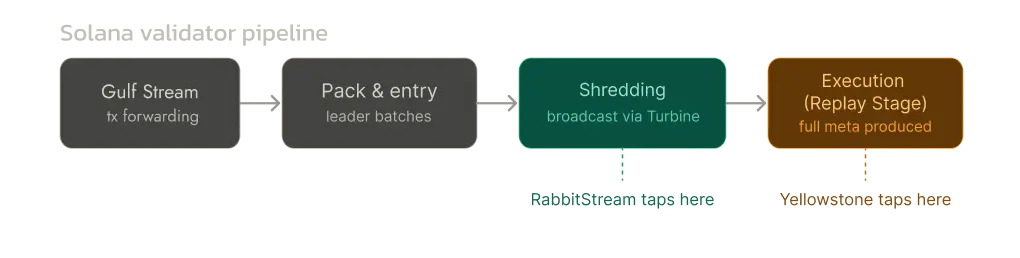
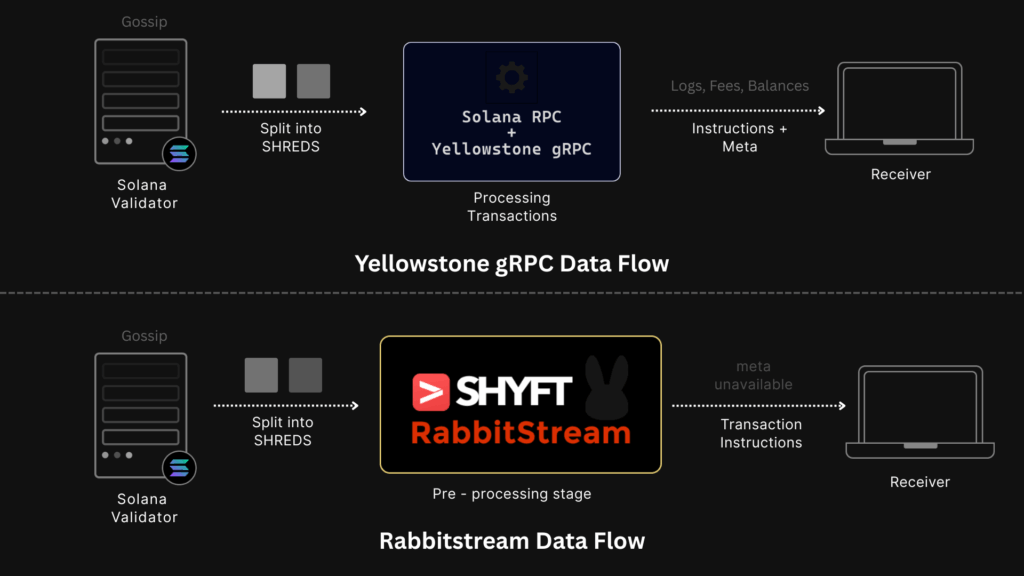
Think of Yellowstone gRPC as the patient observer. The Yellowstone gRPC (Geyser) plugin extracts data after a transaction has been fully executed by the RPC — after gossip, shredding, and execution (replay stage) have all completed.
And when it does, you get the complete picture:
- Full transaction
metafield - Program logs and inner instructions
- Pre/post token balances
- Confirmed execution status
This is the most widely adopted streaming interface in the Solana ecosystem, and for good reason. It’s battle-tested, well-documented, and gives you everything you need to build reliable indexers, dashboards, and data pipelines. If you’re building something where accuracy and completeness matter more than raw speed, Yellowstone is where you start.
The only Trade-off is the time: you’re waiting for execution to finish before the data reaches you.
Shreds — Raw Speed, Pre-Execution
Think of Shreds as the impatient one. Where Yellowstone waits for the full story, Shreds don’t wait at all.
Shreds are the raw binary packets a Solana validator broadcasts to the network the moment a block is being assembled — before any execution has happened. This is the Turbine protocol at work: data propagates across the network as shreds, and your node can pick them up at this stage — before the RPC has even begun to process them.
Because you’re tapping in before execution:
- You see transactions earlier — sometimes tens of milliseconds earlier
- You lose execution context — no
meta, no logs, no final balances
But here’s the thing — not every application needs the full picture to act. A sniper bot targeting a new token launch doesn’t care about post-execution logs. It needs to know a specific program was called, and it needs to know now. For that class of application, the missing context isn’t a limitation — it’s an acceptable trade for being first.
The Real Problem with Raw Shreds
Shreds are fast. Genuinely, structurally fast. But working with them in the raw is a different story:
- No filtering. You receive every transaction Solana processes — including the ~80% that are internal validator votes. Without filtering, you’re drowning in irrelevant data before you can act on anything useful.
- Binary encoding. Raw shreds don’t parse cleanly with standard Solana libraries. You need custom decoding logic just to read them, which is non-trivial engineering work.
- Very Few Providers: The infra complexity means raw shred access is rare, and the providers who offer it price it accordingly — typically outside the range where independent developers or small teams can experiment.
The result: Shred-level speed is theoretically available to anyone. Practically, it’s accessible to almost no one without serious custom infrastructure work. The promise is real — the path to it, without the right tooling, is difficult.
RabbitStream: Shred Speed with Yellowstone Usability
This is exactly the gap RabbitStream was built to close.
RabbitStream taps into the validator at the shred level — capturing transaction data before execution, where the speed lives — and delivers it through a gRPC interface using the exact same SubscribeRequest format as Yellowstone gRPC. The raw speed of shreds, without the raw pain of working with them.
Drop-in Compatible with Your Existing gRPC Code
If you’re already streaming with Yellowstone gRPC, you can point your existing client at RabbitStream with minimal changes. Same subscription format, same filtering syntax — `accountInclude`, `accountRequired`, and all the rest. No new SDK, no new parsing logic, no migration project.
gRPC-Style Filtering on Shred Data
You get account-level and program-level filters applied server-side, so you only receive the transaction stream relevant to your use case. The data overload problem of raw shreds is handled for you.
Transaction Structure You Already Recognize
The streamed transaction structure mirrors Yellowstone gRPC — minus the `meta` fields that don’t exist pre-execution. Your existing processing code largely works as-is.
Note: RabbitStream delivers data before execution completes. A transaction that appears in the shred stream may still fail, be dropped, or get replaced. Any strategy that acts on a pre-execution signal needs logic to handle false positives — either by tolerating some wasted attempts, or by pairing with a Yellowstone or RPC confirmation step before committing capital.
Choosing the Right Stream
The decision is straightforward once you know what your application actually needs from each transaction:
| RabbitStream | Yellowstone gRPC | |
| Extraction point | Pre-execution (shred level) | Post-execution |
| Latency | Lowest possible | Standard gRPC |
| Transaction meta | ❌ Not available | ✅ Full meta, logs, balances |
| Filtering | ✅ Yellowstone-style | ✅ Yellowstone-style |
| gRPC compatible | ✅ Yes | ✅ Yes |
Use RabbitStream when:
- You’re building a sniper or arb bot – you need to react to a specific program being called as early as possible, and you don’t need logs to act.
- You’re setting up high-frequency trigger logic – first-detection of key account activity matters more than full context.
- You want an early signal to front-run your own confirmation logic – detect early with RabbitStream, confirm with Yellowstone or RPC.
Use Yellowstone gRPC when:
- You’re building an indexer or ETL pipeline – you need complete `meta` for data integrity and balance tracking.
- You’re powering a transaction explorer or dashboard – confirmed status, fees, and logs are required for accurate display.
- You’re monitoring wallet activity – final token balance changes only exist post-execution.
Use both together
A common pattern for trading bots: use RabbitStream as the fastest possible trigger to begin processing, then use Yellowstone gRPC or a direct RPC call for confirmation and final decision-making. You get first-detection speed without sacrificing execution context where it matters.
Benchmark
We’ve benchmarked RabbitStream against standard Yellowstone gRPC using a Pump.fun token launch detector — the full code is open source on GitHub.
Consistent speed advantage: ~15ms to 100ms across test runs.
For most use cases that number is irrelevant. For snipers and arb bots, it’s structural.
Getting Started
RabbitStream uses the standard Yellowstone gRPC subscription protocol, so if you’re already familiar with gRPC streaming on Solana, the learning curve is nearly flat.
- RabbitStream Overview
- How to stream with RabbitStream
- Yellowstone vs RabbitStream response comparison
- Pricing
Resources
- Shyft Website
- Get Free API Key
- GitHub
- Join our Discord
Related Posts

Solana Shreds, RabbitStream, Yellowstone gRPC – What Each One Actually Delivers
A developer’s guide to Solana’s data pipeline – from raw shreds to RabbitStream’s partial transa...
August 13, 2026
RabbitStream now supports ALT (Address Lookup Table) resolution, Same coverage as yellowstone gRPC
The last major blind spot in RabbitStream’s transaction coverage is gone. ALT resolution now runs at the shred lay...
July 24, 2026
RabbitStream vs. Jito ShredStream on Solana: A Multi-Region Benchmark
We ran 40,000+ transactions across Frankfurt and New York. Here’s what the data says. TL;DR Multiple benchmark run...
May 21, 2026

Get in touch with our discord community and keep up with the latest feature
releases. Get help from our developers who are always here to help you take off.